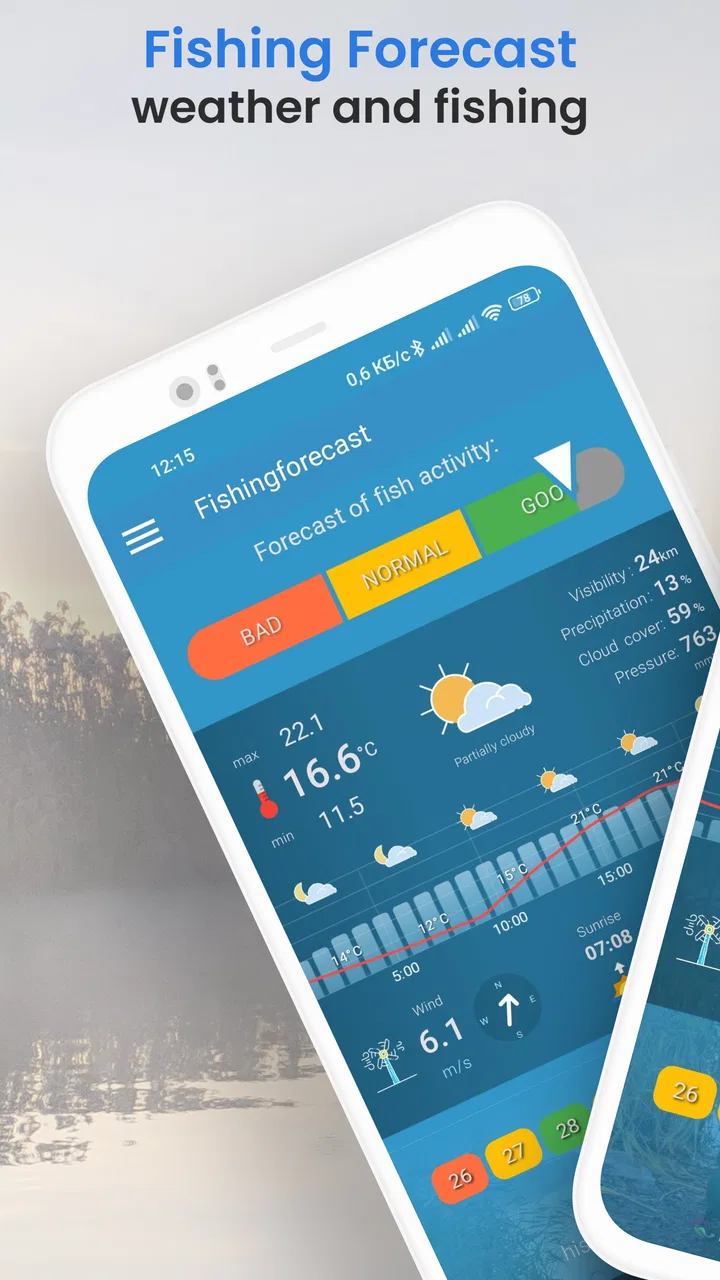
Fishing forecast
- 4.5
- Rating
- 1.00M
- Installs
- Free
- Price

 Analysis by App-foxy
I installed Fishing forecast expecting a simple weather screen with a fishing theme, but its focus is narrower and more useful than a general forecast app. Built by MaxSaur, this free weather app is aimed at anglers who want to decide not only whether the sky looks pleasant, but whether the conditions are worth the trip. Its central idea is pressure data: instead of treating weather as background information, it puts atmospheric changes into the fishing decision.
That distinction matters because a normal weather app is usually designed for commuting, travel, or planning outdoor activities in broad terms. Fishing forecast speaks to a more specific question: is this a sensible time to fish? I found that focus appealing during the first few uses, especially when I wanted to compare a planned outing with the conditions around it rather than simply check the temperature.
The app is free to start, rated 4.5 on average from around 35 thousand ratings, and has passed one million installs. It is suitable for Everyone, runs on Android 7.0 and later, and the current version is 3.7.0. Optional in-app purchases cost $4.99 per item. Those details make it easy to try without committing money first, although the real question is whether the pressure-focused approach remains useful after the initial curiosity wears off.
You May Also Like

 Blood Strike: 2.5 Anniversary
Blood Strike’s Loadouts Turn Every Drop Into a Tactical Gamble
A close look at Blood Strike’s custom loadouts: how fast access to signature weapons reshapes its battle royale rhythm, rewards preparation, and narrows the gap between fights.

 Pandora - Music & Podcasts
Pandora’s Music Is Easy to Start, but Harder to Recover
Pandora’s strength is its low-effort path from a seed to a station. Its weak spot is how much confidence it asks you to place in connection, setup, and quiet recovery.

 8 Ball Pool
 Is Built on Rivalries, Rematches, and Routine
A close look at the rivalries, rematches, shared routines, and unanswered safety questions that turn a quick pool match into a persistent mobile community.

 Samsung Music
’s Quiet Strength Is Playing What You Already Own
Its reach comes less from spectacle than from dependable access to a personal library. That simplicity is both the app’s strongest retention engine and its ceiling.

 AccuWeather: Weather Radar
AccuWeather Review: A Quick, Clear Forecast for Everyday Decisions
For everyday plans, the best forecast is the one you can understand quickly. AccuWeather makes rain timing, radar, and local conditions easy to act on, with a few trade-offs.

 Hill Climb Racing
Why Hill Climb Racing Still Turns Crashes Into One More Run
A tiny car, a bumpy hill and one more upgrade: Hill Climb Racing keeps resurfacing because its simple chaos makes every near-miss feel personal.
More From Our News Desk



From an interesting forecast to a repeatable fishing habit
I found that the useful shift is from checking a forecast once to making a small, repeatable decision before each outing. In the next section, I look at why that routine can still help once the novelty of pressure-focused planning wears off, especially when I compare forecasts with what I actually experience on the water.
Why the first week feels useful
During the first week, the strongest part of Fishing forecast is its ability to make me look at weather with a different purpose. A conventional forecast tells me what conditions are expected. This app encourages me to interpret those conditions through an angler’s routine: choose a day, inspect the pressure trend, and decide whether the trip deserves the time and preparation.
That is a better starting point than relying on a vague feeling that “good weather” must mean good fishing. A bright, comfortable day may be pleasant for me but not necessarily the best choice for the species, water, or technique I have in mind. The app does not remove that uncertainty, but it gives the decision a more relevant reference point than a generic daily forecast.
I also liked that the app is not trying to become a complete outdoor planning suite. Its identity is clear. The store summary describes a fishing weather forecast that helps find a good time to fish with pressure information, and that narrow purpose is reflected in the experience. I can open it with a specific question instead of wandering through unrelated weather layers.
For a new user, the most practical way to test it is to use it before several real trips rather than judge it from one forecast. Check the conditions before leaving, note what the app suggests, and then compare the prediction with what actually happened on the water. That personal record is more valuable than treating any single pressure reading as a promise.
A realistic weekend decision
Imagine I have a free Saturday morning but only enough energy to prepare one outing. My usual weather app might show rain, wind, and temperature. Fishing forecast adds another angle by making pressure part of the comparison between Saturday and the following day. If Saturday has a more appealing pressure pattern, I may accept less comfortable weather. If the pressure looks less convincing, I might delay the trip instead of spending hours traveling and setting up.
This is where the app earns its place during the first week. It does not need to replace my regular weather service. I can use the general app for radar, severe weather alerts, and practical travel details, then use Fishing forecast as the fishing-specific layer. That two-app workflow is more realistic than expecting one focused tool to cover every outdoor need.
The important caution is that pressure should be treated as one clue, not as a guaranteed bite indicator. Water temperature, seasonal movement, bait, clarity, wind direction, local structure, and the target species still matter. The app is most useful when it improves my preparation, not when it encourages me to ignore experience.
Who gets the most from the focused design
I would recommend it first to anglers who fish regularly enough to compare conditions over time. Someone who goes out every weekend can build a useful habit around checking the forecast and recording what happened. It is also a good fit for people who find ordinary weather apps too broad and want fishing conditions presented with a clearer purpose.
It may be less valuable for a person who fishes only when friends invite them, chooses locations based entirely on convenience, or needs detailed navigation and marine safety information in the same place. A specialist forecast cannot replace a map, a local report, or a full boating weather service. If the main concern is whether a storm is approaching or whether a route is safe, a broader weather tool is the better first stop.
The pressure reading needs context
The central trade-off is easy to understand. Pressure data gives the app a distinctive reason to exist, but it can also make the experience feel more authoritative than fishing conditions really are. I found it more useful to watch changes and patterns than to obsess over one isolated value. A single number can look precise while still saying very little about a particular lake, river, shoreline, or species.
My practical tip is to check the forecast at the same point in your planning routine each time. For example, look once when choosing the day, then again before packing. This helps separate a meaningful change from the normal uncertainty of a long-range outlook. It also prevents the app from becoming a source of constant second-guessing.
What remains valuable after the novelty fades
After the first few trips, the app matters less as something new and more as a steady reference for choosing a day and setting expectations. I’ll consider which parts of that routine continue to earn a place on my phone, and when a broader weather source or local report offers more practical value.
Month-to-month usefulness depends on your fishing rhythm
After the first few weeks, the novelty of seeing a fishing-oriented forecast naturally declines. That is not a flaw by itself. Most useful tools become part of a routine, and Fishing forecast has a reasonable chance of doing that for anglers who make regular trips. Its recurring value comes from supporting a repeated decision: go now, wait, or adjust expectations.
For me, the app works best as a short planning checkpoint rather than an app I leave open all day. I can review the upcoming conditions, compare possible days, and move on to tackle, location, and timing. That limited role is actually a strength because it keeps the app from demanding attention between trips.
The long-term benefit also grows when I use it as a personal learning aid. I can remember that a certain pressure pattern coincided with an active morning, while another pattern produced a slow session. The app itself cannot know every local factor, but it can help me notice relationships that would otherwise blur together. This is one of the less obvious ways to get more from it: use the forecast as the beginning of a fishing log, not the final answer.
How it compares with ordinary weather apps
General weather apps usually win on breadth. They are often better choices for radar, hourly rain timing, warnings, travel planning, and a broad view of conditions. They are also familiar, so I am less likely to forget how to use them. Fishing forecast wins on relevance: it frames the information around an angler’s decision instead of making me translate a standard forecast into fishing terms.
That means the two categories are complementary rather than direct replacements. If I want to know whether I need waterproof clothing on the walk to the water, I would still consult a normal forecast. If I want to compare fishing opportunities through the lens of pressure, this app is more direct. The best setup for a serious outing may therefore include both, provided I am comfortable with a small amount of duplication.
It also compares differently with local fishing reports. A local report can include observations from people who were actually on the water, while Fishing forecast offers a repeatable weather-based reference. Reports can be highly specific but inconsistent in timing or detail; the app can be checked whenever I plan. I would not choose one as a complete substitute for the other.
Where recurring value can weaken
The app’s focus can become a limitation when my fishing decisions are driven by factors outside pressure. If I already know the best local conditions from years of experience, the forecast may confirm what I already believe without changing my plan. Likewise, if I fish only at a fixed time because of work or family commitments, “best time” information has less practical power. I may still check it, but I cannot always act on it.
Another source of fatigue is the temptation to keep checking for a perfect window. Fishing rarely offers certainty, and repeated forecast reviews can turn planning into hesitation. I found the app more satisfying when I used it to set expectations: perhaps the day is worth trying, but I should bring a different approach or accept a slower session. That mindset preserves its usefulness without turning it into a decision-making crutch.
Questions about cost and commitment
The free entry point makes the app easy to evaluate during several outings. Optional purchases are priced at $4.99 per item, so I would not pay immediately just because the concept sounds promising. I would first establish whether the forecast changes my plans or improves my preparation. If I open it repeatedly and use its information alongside my own notes, the purchase question becomes personal rather than theoretical.
There is no need to treat the app as an all-or-nothing replacement for other weather tools. A free user can decide whether the focused approach fits their routine, while someone who fishes often can consider the optional items only after seeing lasting value. That is the sensible order: test the habit first, then decide whether additional spending is justified.
Maintenance, friction, and the habits that keep it useful
Keeping the forecast useful depends mostly on how I interpret it, not on checking it constantly. The final section looks at small habits that reduce second-guessing, make comparisons between trips more meaningful, and help me recognize when this focused tool is no longer adding much to my planning.
Low effort, but not zero effort
Fishing forecast is not a high-maintenance app in the usual sense. The main work is interpretive rather than technical. I need to check it at the right time, understand that forecasts can shift, and connect the information with local knowledge. If I expect the app to tell me exactly when fish will bite, disappointment is likely. If I use it as one part of a decision, the maintenance burden stays modest.
The most useful routine is simple: check before choosing a day, check again before departure, and compare the result with what I experienced. I would avoid checking every few hours unless conditions are changing quickly, because that creates noise without necessarily improving the decision. A consistent schedule makes the information easier to compare from one trip to the next.
Keeping a short note outside the app can also improve the experience. I might record the location, target species, time, pressure trend, wind, and result. This is a concrete advanced use that a basic store description would not reveal: the app becomes more valuable when paired with my own observations. Over a season, my notes may teach me more about my local water than any generalized forecast can.
Three practical ways to avoid misreading it
I would compare pressure with the rest of the forecast instead of isolating it. A promising pressure pattern alongside difficult wind or unsafe conditions is not automatically a good reason to go.
I would use the app to choose between realistic options, not to search endlessly for a flawless day. That keeps the forecast connected to actual decisions and reduces checking fatigue.
I would judge it over several outings and different conditions. One slow trip does not prove the app failed, just as one successful trip does not prove the forecast predicted the catch.
These habits also answer an important practical question: can a beginner use it effectively? Yes, but a beginner should treat it as a learning aid rather than an expert system. The app can introduce pressure as a factor worth watching, while local anglers, species knowledge, and time on the water provide the context it cannot supply by itself.
Compatibility and audience
Because the app supports Android 7.0 and later, it remains accessible to people using older Android phones rather than only recent hardware. Its Everyone age rating also makes it suitable for a family device or for younger anglers learning to plan outings. The important point is not the age label alone, but the simplicity of the use case: open the forecast, consider the conditions, and make a more informed plan.
I would still skip it if I need a complete professional weather workstation, detailed waterway mapping, or a broad collection of outdoor tools in one interface. Fishing forecast is strongest when its narrow purpose matches my question. When that question changes, another app may be more appropriate.
What may cause long-term fatigue
The biggest risk is repetition. If every visit produces the same kind of forecast check and I never record outcomes or adjust my approach, the app can start to feel like a ritual without a payoff. That is especially true for occasional anglers who do not have enough trips to notice patterns.
A second risk is overconfidence. Pressure data feels objective, and objective-looking information can encourage false precision. Fishing remains local and unpredictable. The app earns trust when it helps me prepare realistically, not when I use it to justify a guaranteed expectation.
A third risk is divided attention across multiple weather apps. If I already have a favorite service and do not want to compare screens, this specialist tool may feel redundant. Its value is highest when I deliberately assign it one job: fishing timing and pressure context. Keeping that role clear prevents unnecessary duplication.
My long-term verdict on keeping it installed
Fishing forecast earns lasting space on my phone if I fish often enough to make weather-based planning part of my routine. Its focused treatment of pressure gives it a clear identity, and the free starting point removes much of the risk of trying it. I appreciate that it does not need to replace my everyday weather app to be useful; it can sit beside it and answer a more specialized question.
Its lasting value is not in producing certainty. It is in helping me make more deliberate choices, compare possible outings, and build a better understanding of how conditions relate to my own results. That requires a little discipline. I need to check it consistently, avoid treating one reading as decisive, and connect forecasts with what I actually observe.
For a regular angler, that is a worthwhile exchange. The app can turn a vague “maybe I should go fishing” decision into a short, repeatable planning process. For someone who wants alerts, navigation, radar, or a complete marine weather package, a broader alternative will probably be better. For someone who rarely fishes or cannot change their schedule, the benefit may fade quickly.
My recommendation is therefore specific: try Fishing forecast for several real outings, use it alongside your normal weather source, and keep brief notes about what happened. If the pressure view changes how you select days or prepare your approach, it has earned a permanent place. If it merely adds another screen to check without affecting your decisions, uninstalling it is reasonable. In my experience, its strongest feature is not the forecast alone, but the habit of using that forecast thoughtfully.
MaxSaur has built a focused weather app rather than a universal fishing companion, and that restraint is both its appeal and its boundary. I would keep Fishing forecast installed for recurring trip planning, while remaining clear about what it cannot replace: local knowledge, safe-weather judgment, and the unpredictable reality of time on the water.
FAQs for Fishing forecast
01What features does the Fishing Forecast app offer?
The Fishing Forecast app provides a range of features designed to enhance your fishing experience. It includes real-time weather updates, fish activity forecasts, tide schedules, and lunar phase data. Additionally, it offers a location-based fish finder, allowing users to pinpoint the best fishing spots in their area.
02Is the Fishing Forecast app suitable for beginners?
Yes, the Fishing Forecast app is designed to accommodate both beginners and experienced anglers. It offers user-friendly navigation and detailed guides on fish species and fishing techniques. The app also includes tutorials on how to read weather and water conditions, making it a valuable tool for those new to fishing.
03Does the app require an internet connection?
While the Fishing Forecast app offers offline access to certain features, such as previously downloaded maps and guides, an internet connection is necessary for real-time updates. Features like live weather reports and location-based services require connectivity to ensure accurate and timely information.
04Are there any subscription fees for the Fishing Forecast app?
The app offers both free and premium versions. The free version includes basic features like weather updates and fish activity forecasts. However, to access advanced features such as detailed fish finder maps and ad-free usage, users can opt for a subscription, which is available on a monthly or yearly basis.
05How accurate is the Fishing Forecast app's data?
The Fishing Forecast app utilizes reliable sources and algorithms to provide accurate weather and fish activity forecasts. While no app can guarantee perfect accuracy due to the variable nature of weather and fish behavior, users generally find the predictions helpful in planning their fishing trips.
Pros
- Accurate weather predictions enhance planning.
- User-friendly interface for all skill levels.
- Real-time fish activity updates.
- Customizable alerts for fishing conditions.
- Offline mode for remote locations.
Cons
- Limited species data in some regions.
- Requires internet for initial setup.
- Battery-intensive with GPS use.
- Subscription needed for advanced features.
- Occasional app crashes reported.

Fishing forecast
Gallery